
Washoe Three-Day Feed Is Absent
No official WCSO rolling 72-hour release archive was found. The official inmate search shows current custody, requires at least three surname letters, updates about every 15 minutes, and warns that results may be incomplete. Those traits make it useful for a present check. They do not preserve a three-day history.
A true three-day result needs a fixed interval, such as Friday at noon through Monday at noon. WCSO detention transactions can then be requested for that interval. Court orders and Nevada S.A.V.E. alerts are useful cross-checks, but each has its own timestamp and purpose. A court order authorizes action. An alert reports a participating agency’s update. The Sheriff’s release transaction is the best source for when the jail custody episode ended.
Build a Washoe 72-Hour Window
Write down the exact start and end, including time zone. A vague request for “the weekend” can be read in several ways. A precise period helps Records search the right transactions and lets court or alert times be compared on the same basis.
- Choose the exact 72-hour start and end times. State both dates, both times, and Pacific Time.
- Contact WCSO Records and request detention releases recorded inside that interval.
- Ask for name, booking number, release date and time, disposition or destination, and receiving agency where public.
- Review the relevant court dockets for release orders entered during the period, while recognizing that order time is not gate time.
- Compare any Nevada S.A.V.E. alert with the WCSO transaction. Confirm urgent facts directly with the agency.
Use 24-Hour Releases for today’s narrower check. For one named person whose custody path is unclear, start with the Washoe County released-inmate lookup rather than requesting a countywide three-day set.
Washoe Three-Day Record Fields
There are no WCSO feed fields because there is no official feed. The following are request targets from the documented detention-record inventory. A custodian may redact, withhold, or explain that a field is not kept in the requested form.
| Field | Why it matters across 72 hours |
|---|---|
| Name | Identifies the person tied to each transaction. |
| Booking number | Separates repeat bookings and similar names. |
| Booking date and time | Connects release to the correct custody episode. |
| Release date and time | Places the event inside or outside the exact window. |
| Disposition or destination | Distinguishes a community release from a transfer. |
| Releasing authority | May identify the court, sentence completion, or other basis. |
| Receiving agency | Points to the next system if custody continued elsewhere. |
Request data in the form WCSO keeps it. Nevada public-record law does not require an agency to create a new analysis or custom report merely because a requester describes one. If a compiled three-day export is not maintained, ask for the existing release transaction records that fall within the period.
Washoe Weekend Release Reconstruction
A 72-hour range is most valuable when offices, courts, and transport schedules cross a weekend or holiday. An order entered late Friday might not match the final jail transaction time. Bail processing, verification of holds, identity checks, and receipt of court authority can also carry work into the next calendar day. Record each source’s time rather than forcing them into one event.
Review the court named on the booking or bail receipt. Washoe felony and gross-misdemeanor matters may appear through the Second Judicial District Court, while justice and municipal courts handle other local matters. The docket can show an order or disposition. It cannot establish that all holds cleared or that the person walked out at the docket-entry time.
Nevada S.A.V.E. can send release or transfer alerts when supported by a participating agency. It replaced Nevada’s VINE service in 2025. An alert is helpful evidence, but the service is periodic and is not the certified Washoe release record. Always keep the agency and timestamp with the notice.
A holiday range may also cross several court systems. The Second Judicial District Court handles felony and gross-misdemeanor cases, while Reno and Sparks justice and municipal courts have their own jurisdiction and search routes. Begin with the court named on the booking, citation, or bail receipt. Searching only the district court can miss a still-public local case. When a docket shows dismissal, bond, recognizance, or time served, record the wording exactly and then check whether the detention transaction followed inside the chosen window.
Calendar boundaries deserve care. A 72-hour span is not always the same as three labeled calendar dates. A request covering midnight Friday through midnight Monday excludes events after the Monday endpoint, while a Friday-noon through Monday-noon request includes a different set. State Pacific Time and avoid phrases such as “the last three days” when sending the request. Precise limits make the answer reproducible and reduce the chance that a late Sunday or early Monday release falls outside the returned set.
Request Washoe 72-Hour Records
The WCSO Records Section is the central detention-record repository. Its listed address is 911 Parr Boulevard, Reno, Nevada 89512, and its records number is 775-328-3023. The Sheriff’s current page provides appointment information, request links, and its fee schedule. Nevada’s NRS Chapter 239 provides a five-business-day response framework, which may result in production, an exemption explanation, a future production date, or notice that another office has the record.
Describe the set narrowly by giving the precise beginning and ending timestamps in Pacific Time, followed by the requested fields. Ask for an estimate if fees may apply. The countywide public-record portal is a fallback, but direct Sheriff requests should start with WCSO because it is an elected office with its own records route.
The official records page identifies the repository that handles this request.
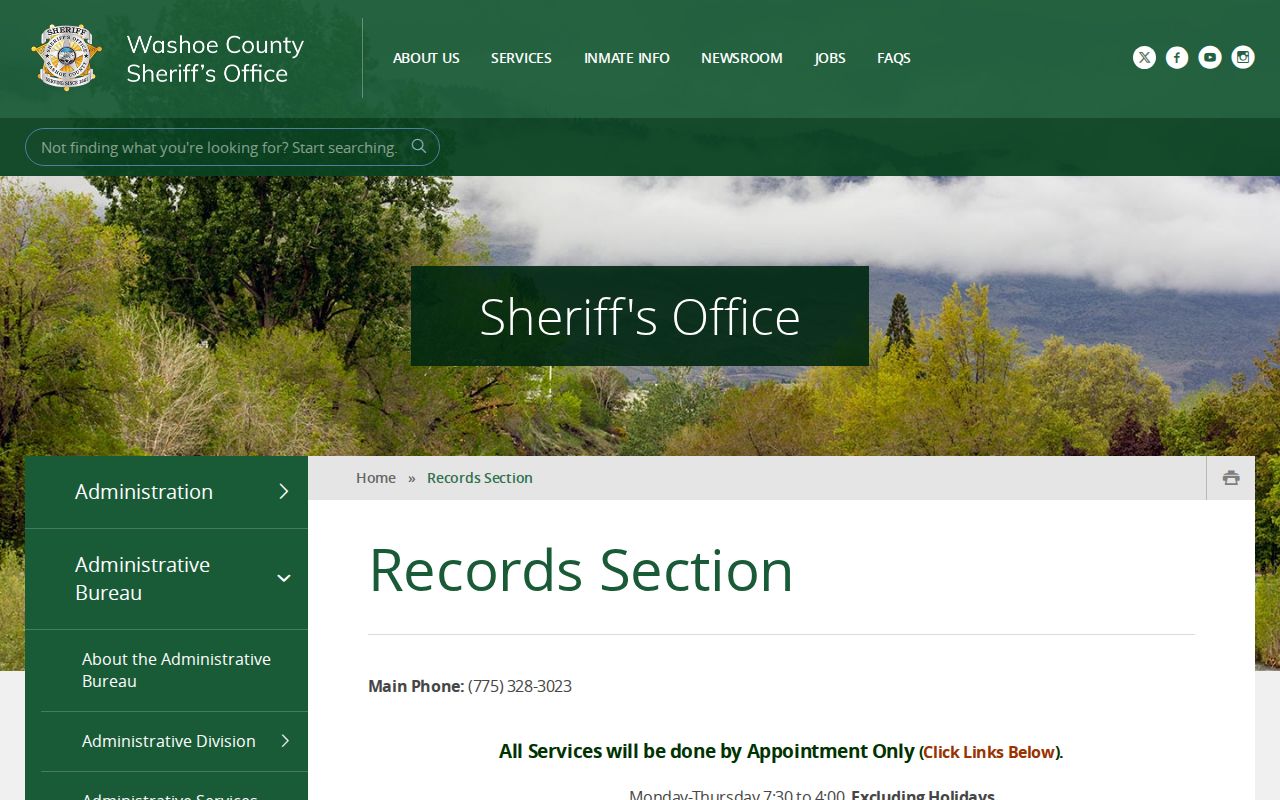
Use the live page for current hours and routing, then keep the response with the reconstructed window.
Washoe Roster Timing Limits
The current roster’s 15-minute update schedule is easy to misread. It means WCSO refreshes present custody data at intervals. It does not mean the public can retrieve each past version or identify every departure since the prior refresh. The search can also be incomplete, and a last name needs at least three letters.
The WCSO gateway states the current-custody and publication limits.
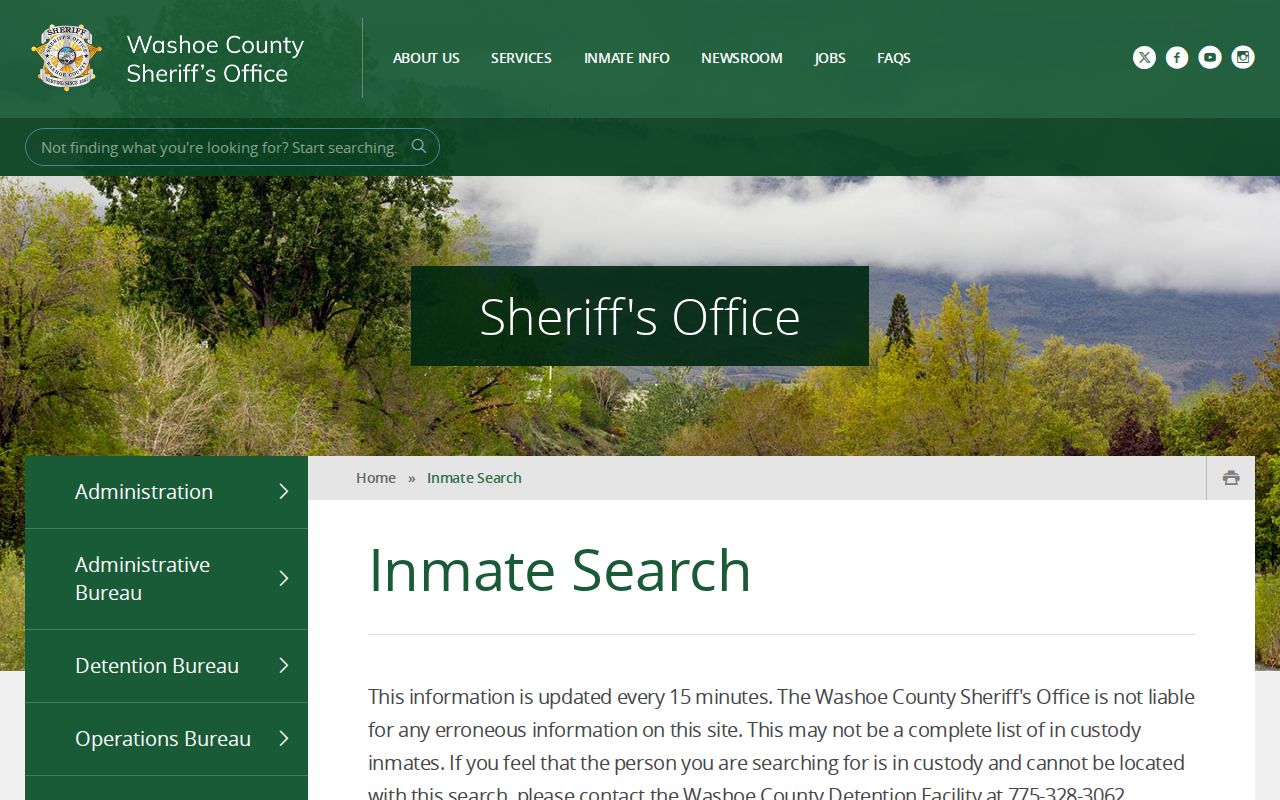
This screen supports a current check only. It should be cited as proof that the rolling release archive is absent, not presented as the archive itself.
Washoe Release or Transfer
A jail departure can end WCSO custody without placing the person in the community. Transfers may lead to NDOC, another jurisdiction, federal or immigration custody, a hospital, or another secure setting. Ask for disposition, destination, and receiving agency to the extent public. Then use the receiving system to confirm continued custody.
| Outcome | Next confirmation |
|---|---|
| County community release | WCSO release transaction and any court order |
| State-prison transfer | Nevada Department of Corrections Offender Search |
| Release to supervision | Nevada S.A.V.E. and the Nevada Division of Parole and Probation |
| Federal transfer | BOP locator, federal docket, or the responsible federal office |
Never label a transfer as a release to the community. The three-day record should preserve the disposition even when the person no longer appears on WCSO’s current roster.
When records name no destination, do not fill that gap with a guess. Keep the outcome unresolved and contact the releasing or receiving office. A no-result in another locator can reflect intake lag, a spelling difference, or a system outside that locator’s scope. A careful 72-hour reconstruction records both what each source confirms and what it does not confirm. That approach is slower than a public feed, but Washoe County has no verified feed to replace it. The result remains tied to official transactions instead of an unsupported inference from a changing roster.
State and federal systems require separate checks. NDOC’s Offender Search covers people with Nevada prison histories, not ordinary jail-only bookings. A new NDOC entry may lag a county transfer. The federal BOP locator can show federal custody or a released status for covered records, but it does not document a county release transaction. Immigration detention has its own locator, where a missing result is not proof of release. If the receiving agency is not named, ask WCSO Records whether a public disposition or destination field can identify the next custodian.
Keep negative findings too. Note the locator searched, the spelling used, and the time of the check. That record helps explain why a transfer remained unresolved and prevents a later search result from being treated as if it had been visible throughout the full 72-hour period.