
Understanding Washoe County Releases
A Washoe County release means one custodian has ended a specific period of confinement. It does not always mean the person walked into the community. The Washoe County Sheriff’s Office may release an adult on recognizance, after bail, by court order, after time served, or at the end of a local sentence. The same detention record may instead show transfer to the Nevada Department of Corrections, another county, the U.S. Marshals Service, immigration authorities, a hospital, or another secure setting. The destination matters as much as the word “release.”
The live WCSO inmate search is built around current bookings. A name that drops off is a clue, not proof of community release. Call the published detention status line, check Nevada S.A.V.E., search the likely receiving agency, and request the actual release transaction when the result must be reliable. State custody works differently. An NDOC record can show institutional release to parole, full discharge, or a move to another state facility.
- Time served
- The court-ordered jail term has been completed.
- Parole
- Prison confinement ends, but state supervision continues.
- Probation
- A court orders community supervision, which may occur without an NDOC prison release.
- Discharge
- The sentence or supervision obligation ends as reflected by the responsible agency.
- Detainer
- Another agency asks the jail to hold or transfer the person under lawful authority.
Washoe County Release Types
The next search depends on how custody ended. A bond or recognizance release usually points back to the Washoe court and WCSO detention record. A prison transfer requires NDOC. A federal or immigration handoff requires the receiving federal system. None should be treated as interchangeable.
| Release or movement | What it means | Best next record |
|---|---|---|
| Recognizance or bail | The court authorized release while the case continues. | WCSO release transaction and the named court docket |
| Time served or local sentence complete | The required county-jail custody ended. | WCSO detention record and judgment |
| Dismissal or court order | The court supplied authority to release on that case. | Court minute or order plus the jail timestamp |
| NDOC transfer | County custody ended, but state confinement began or continued. | NDOC Offender Search and release history |
| Parole | Institutional custody ended while P&P supervision began. | NDOC status, Board action, S.A.V.E., and P&P |
| Federal or ICE transfer | The person moved to another custodian. | BOP, ICE, federal docket, or receiving agency |
Is a transfer the same as release? No. It closes one agency’s custody entry while another agency may take control. Confirm the destination before describing the person as free in the community.
Washoe Bond Release Process
Washoe Pretrial Services interviews all inmates within 24 hours for possible release on recognizance. Recognizance means a court permits release based on a promise to return, without requiring a cash bond. If that route is not granted, the court may set bail or keep the person detained. WCSO identifies accepted bail instruments and directs questions about the controlling court to the court named on the bail receipt.
A receipt shows that payment was accepted. It does not show the moment the jail completed release. Staff must check holds, finish records, return property, and complete other steps. That is why the WCSO custody transaction remains the key proof of the physical departure. The court docket supplies the legal reason, while the jail record supplies the actual date and time.
Note: A bail payment and a jail departure are separate events, so preserve both timestamps when reconstructing a Washoe County release.
Washoe County Release Record Fields
A useful release-record request names the fields needed to distinguish community release from transfer. Asking only for an “inmate file” is broad and can slow the response. Identify the person, booking number if known, and a narrow date range. Then request the detention or booking release record and code definitions.
| Field | What it shows |
|---|---|
| Booking number | Links the release to the correct custody episode. |
| Booking date and time | Marks when that jail episode began. |
| Release date and time | Records when WCSO closed custody for the booking. |
| Disposition or type | States the coded reason, such as bond, time served, court order, or transfer. |
| Releasing authority | Identifies the court or lawful basis for release. |
| Destination or receiving agency | Separates community departure from continued custody elsewhere. |
| Holds or transfers | Shows whether another jurisdiction affected the departure. |
| Charges and court | Ties the booking to the court route that may explain the outcome. |
Some fields may be withheld, redacted, or confidential. Juvenile records follow a separate restricted system. A sealed adult court record can also limit public access, but Nevada generally uses record sealing rather than destruction of every copy. A no-result after sealing does not prove that no custody event occurred.
Request Washoe County Release Records
WCSO’s Records Section is the central repository for detention records. Its official Records Section page links the request route and current fee information. The office at 911 Parr Boulevard is appointment-only, Monday through Thursday from 7:30 a.m. to 4:00 p.m., with a noon to 1:00 p.m. lunch closure and holiday closures. The records line is 775-328-3023.
- Use the WCSO GovQA portal and choose electronic delivery when practical.
- Give the full name, a useful identifier, booking number if known, and a narrow date range.
- Ask for the “detention/booking release record,” not a vague complete inmate file.
- List the release time, disposition, code definition, authority, destination, and holds or transfers.
- Request a written estimate if costs may apply, then preserve the response and supplied record together.
The current WCSO schedule says paper case copies and booking photos have no charge, while a flash drive is $10 and added processing may cost more. An older photo form describes a $25 CD and at least ten working days. Because official materials conflict, the current written quote controls. Nevada’s public-record law sets a response framework, not a promise that every record will arrive within that period.
The manifest image below comes from the WCSO detention-record repository.
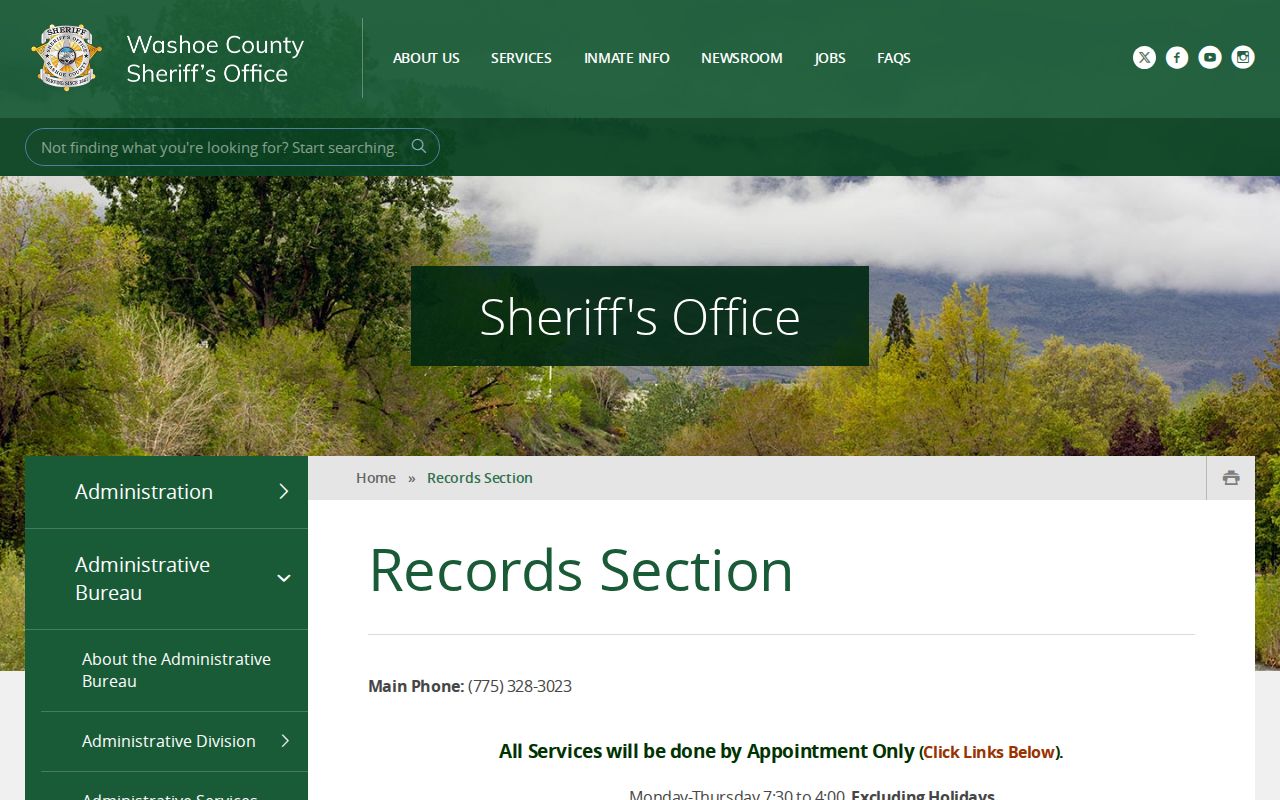
It confirms the agency route used when a released person no longer appears in the current-custody search.
Washoe Release Record Law
NRS Chapter 239 creates Nevada’s general presumption that public books and records are open unless another law makes them confidential. Under NRS 239.0107, a custodian must act by the end of the fifth business day. The agency may provide the record, permit inspection, state when it expects the record to be ready, cite legal authority for denial, or state that it does not hold the record. That five-day rule governs the response, not guaranteed completion of a complex request.
NRS 239.052 permits actual copy costs and an extraordinary-use fee when a request needs unusual staff or technology resources, after a written estimate. Narrow requests reduce ambiguity and cost. Juvenile files, sealed records, and confidential material remain subject to other rules. Nevada record sealing under NRS Chapter 179 can restrict official dissemination. It does not promise that every independent copy will vanish.
When Washoe Jail Releases Occur
WCSO publishes two useful operating expectations. Once valid bail is posted, release processing may take up to eight hours. Usual time-served releases occur at 5:00 a.m. Neither statement predicts a named person’s exact departure. Holds, court changes, identity checks, property steps, and a transfer decision can affect the result.
The release transaction supplies the actual timestamp. Nevada S.A.V.E. alerts and court events can support the timeline, but each reflects a different system. An alert may precede or lag the custodian’s final entry. Record both the source and timestamp whenever timing matters.
Note: The usual Washoe process is an operating guide, while the named booking record is the evidence of actual release.
Travel After a Washoe Release
The Sheriff states that it does not provide transportation after release from the Parr Boulevard facility. Its release-procedure page refers to bus service between the detention facility and downtown Reno, though the page’s “Citi-Fare” name is dated. Use the current Regional Transportation Commission service for present route and schedule planning rather than relying on that old label.
This detail matters when meeting someone after release. Processing can take hours, and the stated time is not a promise. Confirm that release actually occurred, agree on a safe meeting point, and check current transit service. A transfer to NDOC, ICE, USMS, a hospital, or another jail will not end at the public release point.
Washoe Post-Release Digital Property
WCSO documents an unusual post-release option for personal digital material. A former inmate may sign into SmartInmate with the inmate number and password to download personal photos, messages, and scanned postal mail without charge. These items belong to the person’s communications account. They are not the official booking photograph and do not replace a detention release record.
Keep the inmate number and login details secure. If access fails, use the contact route on the WCSO visiting and mail page. A separate GovQA request is needed when the goal is an agency-held booking photo or release document.
Find Washoe County Released Inmates
A complete Washoe County released inmate search moves from the narrowest local source to the system that may have received the person. The official jail roster is only the first check. It updates every 15 minutes, requires at least three surname letters, and can be incomplete. No verified official WCSO 24-hour or 72-hour release archive exists.
- Search the current WCSO roster. Record the spelling and booking number if a result appears.
- If the person is absent, call the detention status line at 775-328-3062 and ask whether WCSO still holds that booking.
- Search Nevada S.A.V.E. for custody or supervision and NDOC for a state-prison record.
- Check the court shown on the booking, citation, bail receipt, or judgment for the order and case disposition.
- Use BOP, ICE, or the federal docket if the facts point to federal custody.
- Request the WCSO release transaction for the date, time, type, and destination.
The Washoe County 24-Hour Releases page explains the same-day fallback in more depth. For a named person, however, the release transaction and receiving-system checks remain the strongest path.
Washoe NDOC Release Search
The Nevada Department of Corrections Offender Search covers state offenders, not ordinary Washoe jail-only bookings. Search by offender ID or name. A record may supply the NDOC ID, status or location, physical descriptors, a photo where available, sentence details, and labeled parole-eligibility, projected-expiration, or release information. Read each label exactly. A projected date is not an actual release.
| Search or result field | How to use it |
|---|---|
| Offender ID | Best identifier when known and useful for matching other NDOC records. |
| Name | Use spelling variants and compare identifiers before accepting a match. |
| Status or location | Distinguishes prison placement, parole, and other labeled states. |
| Sentence rows | Shows case-based terms that can affect projected dates. |
| PED or PEXD | Projected labels that may change and must not be called actual release. |
| Release row | Historical date and description when NDOC supplies them. |
The official NDOC search controls appear in the captured source below.
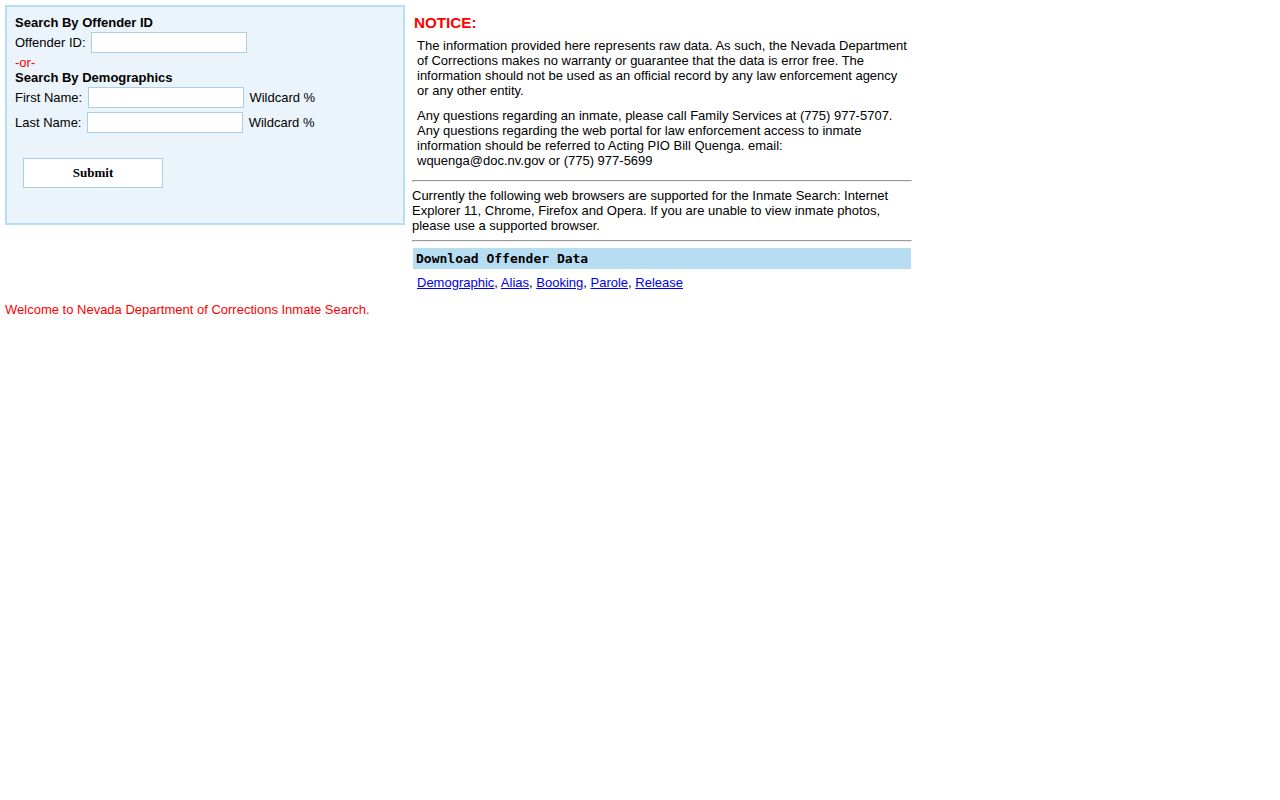
The name and ID routes help identify a state record, but an underlying NDOC record is still needed when public fields are blank or unclear.
Washoe Release Orders by Court
Washoe County court records are split across several systems. The Second Judicial District Court handles felony and gross-misdemeanor matters after bind-over or indictment. Reno, Sparks, and Incline Village-Crystal Bay justice courts handle township matters and early felony stages. Reno and Sparks municipal courts handle their city ordinance and misdemeanor cases. Start with the court printed on the booking, complaint, citation, bail receipt, or judgment.
Read the docket in time order: arrest, first appearance, bail or recognizance, bind-over, dismissal or plea, judgment, custody credit, sentence, probation, remand, discharge, and sealing. A court order explains the authority to leave. It does not prove the jail’s physical release time or rule out another hold. Obtain the minute or order if a docket label is vague.
The Second Judicial District Court jurisdiction page is shown below.
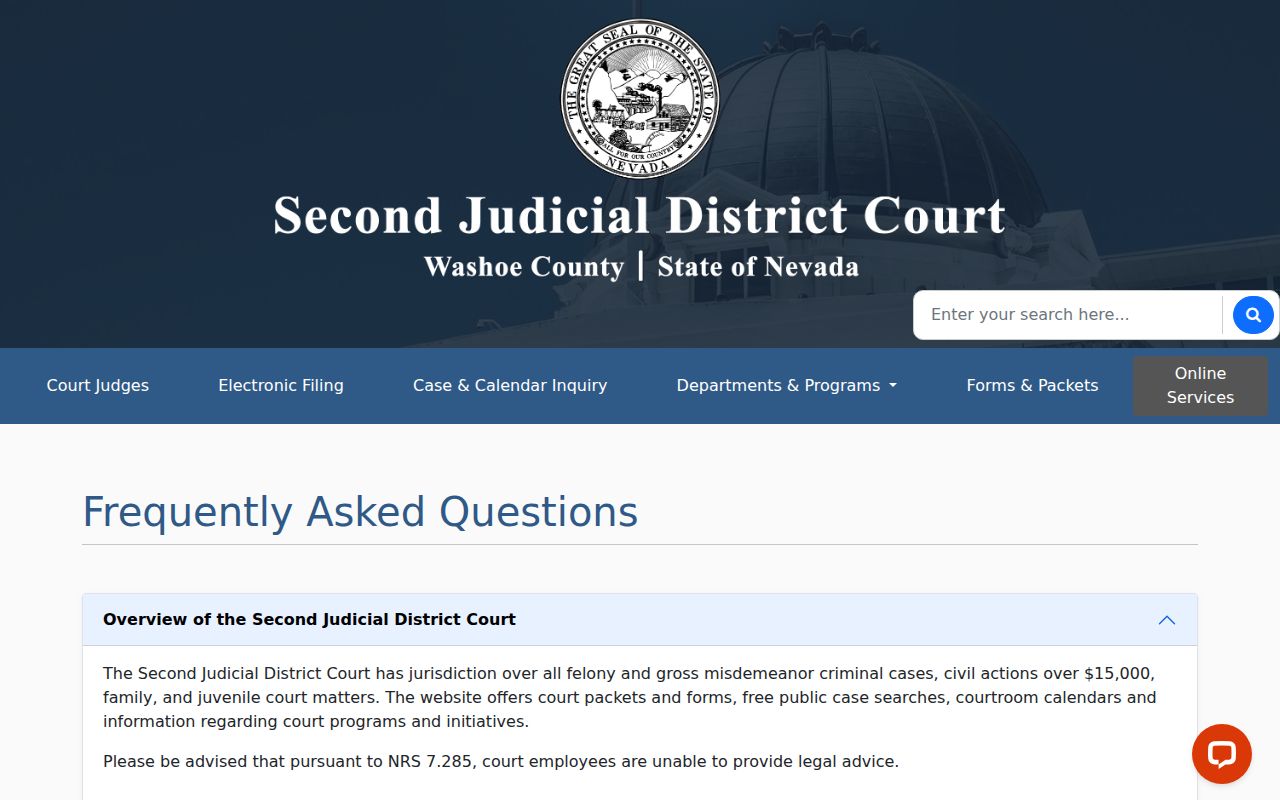
The court split explains why a search in only one Washoe portal can miss a still-public case.
Washoe Release Supervision Checks
The Nevada Board of Parole Commissioners decides parole, while the Nevada Division of Parole and Probation supervises parolees and probationers. A Board grant is not a gate release. The person must reach the eligibility date, clear holds, and receive approval of the release plan. NDOC’s release transaction and a S.A.V.E. event provide later evidence that institutional custody ended.
Search NDOC for the ID and status, then check S.A.V.E. and the Board’s Monthly Parole Actions. Compare the action date with any effective date. P&P can confirm routing when public tools do not settle the issue. The Reno P&P number published in the research is 775-684-2300, with general P&P at 775-684-2600. No authoritative public statewide absconder database was found.
More detail on the Board, P&P, and verification order appears under Washoe County Post-Release Supervision.
Washoe Release Reentry Resources
WCSO’s Detention Services Unit describes its role as a bridge between people preparing for release and community resources. The agency publishes a Community Resource Guide and an outreach contact through its inmate-services material. This local connection begins before the custody event ends and can help with practical needs after departure.
Northern Nevada Transitional Housing creates a second Washoe-area layer. Residents take part in community programs while nearing parole eligibility or term expiration, but they remain NDOC offenders. An NNTH placement is not a release. Actual parole or discharge must appear through NDOC, then P&P becomes relevant if supervision follows.
Washoe Release Alerts Through SAVE
Nevada S.A.V.E. replaced VINE for Nevada searches and alerts in August 2025. Search by a full or partial name or supported ID, review the source agency and status, and register for phone, email, or text notices. A result may represent incarceration or community supervision. A no-result is not a historical release certificate because people no longer in custody or supervision may disappear from public search.
The Nevada S.A.V.E. search is captured below.
S.A.V.E. is a notification system, not the originating detention record. Confirm an important change with WCSO, NDOC, P&P, or the court that supplied it.
Washoe Release Registry Boundaries
Washoe has three distinct registry layers for qualifying registrants. Nevada operates the statewide registry. Washoe County, Reno, and Sparks share an OffenderWatch public portal. The Washoe Tribe runs its own registry for qualifying people who reside, work, attend school, or enter tribal lands. These systems serve a limited statutory notification role.
No single registry is comprehensive. Most Washoe County released inmates will not appear, and a listed person’s presence does not establish the jail release date. Use the registry only for the public-safety function defined by law, then use the custody record to answer a release question. Tribal, local, and state coverage must not be collapsed into one source.
Washoe Federal Release Searches
The Federal Bureau of Prisons locator is the right first tool for a person who served a federal prison sentence. Results may show “Released” with a date or “Not in BOP custody.” Neither phrase rules out state custody, immigration custody, or federal supervised release. The online locator covers federal inmates from 1982 forward, and dates can change after credit calculations.
ICE’s locator serves present immigration detention and certain people released from ICE custody during the prior 60 days. Search by A-number and country of birth or exact biographical details. A WCSO disposition to ICE is a transfer, not community release. The U.S. Marshals Service has no comparable public name locator for its pretrial and transport prisoners, so use the federal court docket and later receiving-agency record.
Washoe Custody and Release Sources
Match the source to the custody level. A current roster answers a current-custody question. A release record answers when and how that custody ended. State and federal tools cover different populations.
| Source | Best use | Key limit |
|---|---|---|
| WCSO inmate search | Current adult county-jail booking | Absence is not proof of release |
| WCSO release record | Actual county release time, type, and destination | Requires a focused records request when not public online |
| NDOC Offender Search | State-prison status, parole, discharge, and date fields | Not a county-jail archive |
| Nevada S.A.V.E. | Custody or supervision status and alerts | Periodic notification data, not a certified record |
| Court docket | Release authority, disposition, and sentence | Does not prove physical departure or clear another hold |
| BOP or ICE | Federal prison or immigration custody route | Each system has distinct scope and retention |
Washoe County Release Facilities
Three facilities in Washoe County require three different release routes. The adult jail uses WCSO records. Transitional housing remains part of NDOC. Juvenile detention uses confidential family, attorney, and court channels rather than a public name search.
- Washoe County Detention Facility holds adult pretrial and locally sentenced people. Confirm release or transfer through WCSO.
- Northern Nevada Transitional Housing is a 112-capacity NDOC site at 225 Sunshine Lane. Community programming does not end state custody.
- Jan Evans Juvenile Justice Center / Wittenberg Hall serves juveniles. Release may be to a parent, guardian, supervision, or court-ordered placement, with records restricted by law.
Northern Nevada Correctional Center and Stewart Conservation Camp are in Carson City, while Lovelock Correctional Center is in Pershing County. They may hold people convicted in Washoe County, but they are not Washoe County facilities.
Why NNTH Has Old Listings
Northern Nevada Transitional Housing is the current NDOC facility at 225 Sunshine Lane in Reno. Older official search results may still identify its predecessor, the Northern Nevada Restitution Center, at a different address. The facility transition and a land arrangement involving the Reno-Sparks Indian Colony help explain why those stale entries persist.
Use the current NDOC NNTH page for contact and capacity facts. Historical restitution-center pages can explain the prior name, but they should not route a present inquiry. A current NNTH status still means state custody, even when the resident participates in work or community programming.